Apple M-Series Powers Mobile Military Simulations
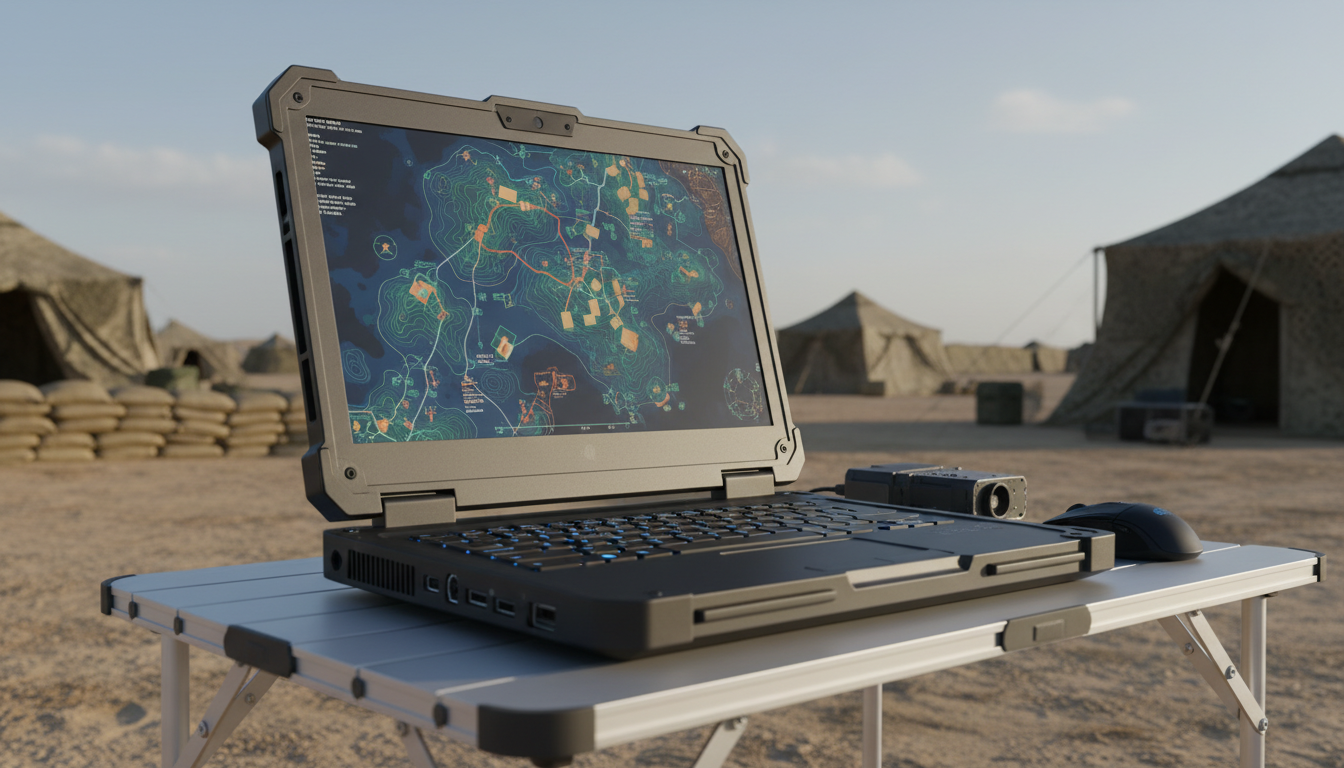
Unified Memory Eliminates Data Bottlenecks
Unified Memory Architecture (UMA) designs integrate the CPU, GPU, and Neural Engine into a single System on a Chip (SoC) that shares a common memory pool. This approach eliminates the need for data transfers between separate CPU and GPU memory banks, directly addressing data exchange bottlenecks common in traditional HPC platforms, as detailed by Colorado School of Mines undergraduate research, PreScouter, and a preprint by Hübner, Hu, Peng, and Markidis. Flopper.io and Scalastic.io report that high-end NVIDIA GPUs, such as the H100 SXM, deliver 67 TFLOPS of FP32 computational power, outperforming the M4 Max's 18.43 TFLOPS by three to four times. Colorado School of Mines undergraduate research states, "Standard high performance computing platforms typically have CPU and GPU memories segregated which creates data transfer bottlenecks." The research further notes that data-heavy and computationally sparse workloads, such as Finite Difference Time Domain (FDTD) electromagnetic simulations, "suffers heavily from this data exchange bottleneck." Flopper.io reports that the M5 Max, for instance, achieves memory bandwidths up to 614 GB/s, ensuring memory-capacity-bound workloads are fed efficiently without PCIe limitations. Flopper.io, Interesting Engineering, and Scalastic.io highlight that this large unified memory capacity, exemplified by the 192 GB supported by the M2 Ultra, enables the local execution of massive AI models. These include 70B parameter Large Language Models (LLMs), which can be integrated into military simulations for intelligent agents or decision support.
Neural Engine and MLX Accelerate AI
Apple Machine Learning Research, a preprint by Hübner, Hu, Peng, and Markidis, The Eclectic Light Company, Scalastic.io, Apple, and Apple Developer detail how the Neural Engine and ML accelerators, accessible via frameworks like MLX and Core ML, significantly enhance inference performance for real-time AI/ML workloads within military simulations. Flopper.io and Scalastic.io assert that this capability is crucial for integrating intelligent agents, environment modeling, and decision support systems into simulations without creating a fundamental bottleneck. The M-series architecture also enhances simulation realism through hardware-accelerated ray tracing. This improves the accuracy and visual fidelity of rendered environments, as observed by a preprint by Hübner, Hu, Peng, and Markidis, and Apple.
M-series GPUs Lack Native FP64 Support
A preprint by Hübner, Hu, Peng, and Markidis, Scalastic.io, and the Max Planck Society report that the absence of native double-precision (FP64) floating-point support is a significant limitation for high-fidelity military simulations. The same sources indicate this restricts their utility in HPC workloads demanding high numerical accuracy, such as complex ballistics, fluid dynamics, or certain electromagnetic modeling, where precision errors can compromise simulation realism and validity. The preprint by Hübner, Hu, Peng, and Markidis, Scalastic.io, and the Max Planck Society explain that while FP64 operations can be emulated, this workaround is computationally expensive. It may not always justify the chip's other architectural benefits for applications requiring strict IEEE 754 compliant outputs.
CUDA Entrenchment and No Multi-node Scaling
Scalastic.io highlights that the defense sector's entrenched reliance on NVIDIA CUDA and x86 architectures creates a substantial adoption barrier for large-scale training and supercomputing clusters. A preprint by Hübner, Hu, Peng, and Markidis, along with Scalastic.io, observes that Apple's ecosystem, which relies on Metal, Metal Performance Shaders (MPS), and MLX, is less mature than CUDA. They note that some CUDA-optimized libraries lack direct equivalents on Apple Silicon. Colorado School of Mines undergraduate research and Scalastic.io indicate that porting existing, specialized HPC codes to Apple's Metal API and ARM architecture requires significant optimization effort and re-engineering costs. Colorado School of Mines undergraduate research also states that Apple Silicon does not support multi-node scale-out or high-speed interconnect fabrics like NVLink or InfiniBand, fundamentally limiting its deployment in large-scale supercomputing clusters.
M-series for Localized AI and Mobile Nodes
Apple M-series chips offer distinct advantages for localized AI agent modeling, real-time inference, rapid prototyping, and power-efficient simulation nodes in mobile or field-deployable military environments. The architectural benefits, including reduced data transfer bottlenecks and lower power consumption, position them as highly effective for these specific applications. However, for military simulations demanding the highest numerical accuracy or large-scale, multi-node distributed training, the current limitations of M-series chips necessitate continued reliance on traditional HPC architectures and CUDA-based solutions.
Comments ()