Conditional Peace Traps Ukraine
Trump's 2025 Plan Cedes Crimea, Donbas
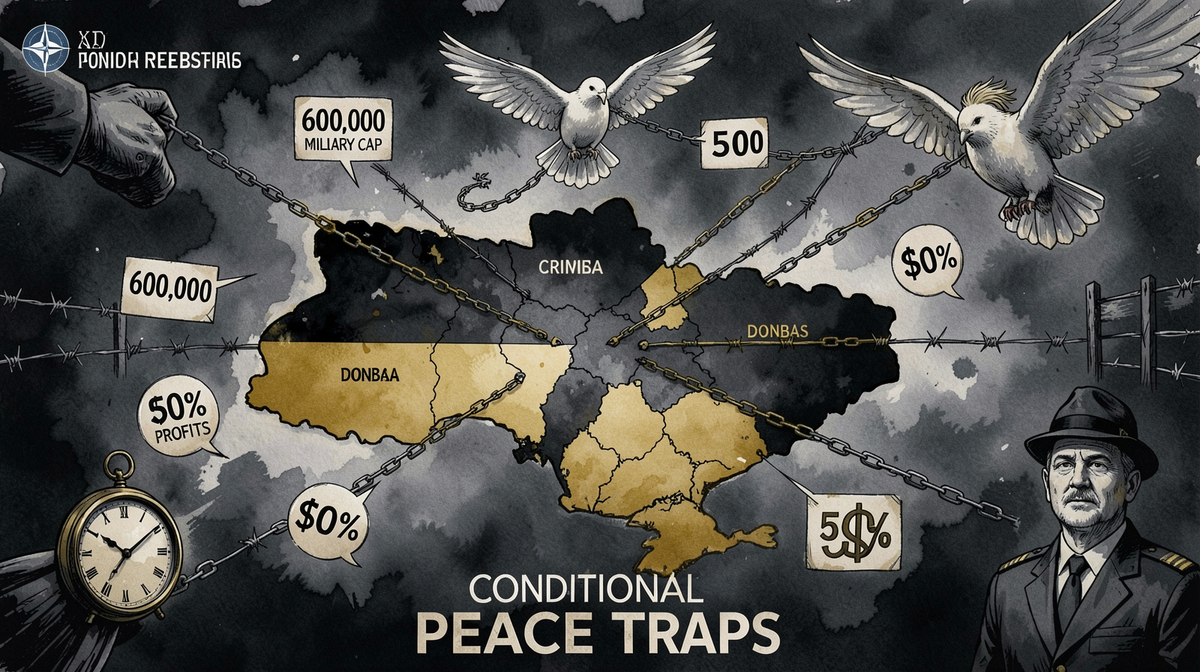
CSIS outlined that the US 28-point draft proposal specifically envisions recognizing Crimea, Luhansk, and Donetsk as de facto Russian territory, freezing front lines in Kherson and Zaporizhzhia, and requiring Ukraine to withdraw from the portion of Donetsk it still controls. The Trump administration's November 2025 peace plan caps Ukraine's armed forces at 600,000 personnel and bars Kyiv from NATO membership. The Carnegie Endowment and Oxford found that most Ukrainians strongly oppose territorial concessions and foreign control over national resources. The Harvard Davis Center, VIF India, CFR, and Policy Magazine described scenarios such as unconditional concessions in Donbas, deferring the status of Crimea and Sevastopol for 10 to 15 years, or ceding territory while being barred from NATO membership as constituting a "pragmatic path."
FIIA observed that while the war has concentrated significant power in Zelenskyy and his Office, diminishing oligarchic influence, pushing through constitutional changes or seeking a second term under martial law could create major conflict with a society demanding change. These concessions profoundly impact President Volodymyr Zelenskyy's political capital. FIIA and VIF India warned that trading land for peace without durable security guarantees could severely damage his political standing and public trust. The Quincy Institute and a ScienceDirect peer-reviewed article found that provincial political factions, historically anchored in local patron-client networks, are viewed by the central government as vulnerable to Russian influence.
US Claims 50% of Russian Asset Profits
CSIS disclosed that, according to a draft proposal for economic integration, the United States envisions receiving 50% of the profits from frozen Russian assets for Ukrainian reconstruction. CSIS and the Quincy Institute contended that this framework would transfer key financial leverage from Ukrainian institutions to foreign contractors and governments, prioritizing Western profit shares over direct national compensation. This contrasts sharply with European counterproposals; CSIS pointed out that these demand frozen assets remain frozen until Russia compensates Ukraine. This divergence complicates a cohesive domestic consensus, potentially deepening the divide between technocratic elites prioritizing immediate reconstruction funding and nationalist factions defending sovereign control over Ukraine’s economic future. The Carnegie Endowment and Global Affairs observed that while wartime centralization has shifted patronage toward the Presidential Administration, transferring financial leverage to foreign entities under these terms is more likely to deepen this divide.
600,000 Personnel Cap, US $162 Billion Aid
Georgetown and Russia Matters calculated that a cap of 600,000 personnel, as proposed in some plans, would require the Ukrainian Armed Forces to reduce personnel by approximately 200,000 to 250,000 service members. Proposed caps on Ukraine’s armed forces, restrictions on heavy weaponry, and deep dependency on Western aid directly influence Kyiv’s military sovereignty and shift defense policy-making. CSIS highlighted that, in contrast, a European counterproposal suggested a higher cap of 800,000 personnel in peacetime, while another European proposal imposed no numerical restrictions.
Oxford documented that Ukraine has become more sovereign and capable than at any point since 1991, producing over 1.2 million drones in 2024. However, this domestic capability coexists with deep structural dependency on Western procurement and financing. The United States provided roughly $162 billion through mid-2025, while European allies have committed billions annually to backfill US aid. The Carnegie Endowment estimated total reconstruction needs at $524 billion, with only $7.4 billion secured for 2025. FIIA determined that this external dependency has mechanically shifted domestic defense policy-making away from traditional electoral accountability, concentrating power in President Zelenskyy's Office due to postponed elections under martial law. FIIA further explained that Western conditionality attached to aid packages and EU candidate status directly shapes Kyiv’s domestic reforms and defense sector governance.
Trump's Conditional Guarantees, EU's $90 Billion Loan
Brookings found that in early 2026, European governments collectively ratified a $90 billion multiyear loan package for Ukraine, a response to conditional security guarantees that have heightened European anxieties about American reliability. CSIS revealed that the US 28-point draft proposal offered vague security guarantees that would lapse if Ukraine attacked Russia, even unintentionally, while claiming a 50% share of profits from frozen Russian assets for reconstruction. This directly conflicted with European preferences; CSIS highlighted that the EU counterproposal demanded assets remain frozen until Russia fully compensates Ukraine. Brookings found that this divergence has heightened European anxieties about American reliability. In response, European nations have accelerated their own defense integration. Germany, for instance, loosened its constitutional "debt brake" to increase military spending, and European governments collectively ratified a $90 billion multiyear loan package for Ukraine in early 2026. Brookings and Vision of Humanity posited that this shift toward European strategic autonomy is complicated by internal divisions, but transactional US guarantees may force Europe to confront its structural defense weaknesses more urgently.
Kyiv Vulnerable to Western Will, Russia
The evidence indicates that land-for-peace deals, under current frameworks, would fundamentally alter Ukraine's long-term security architecture by embedding it as a vulnerable buffer state. This would leave Kyiv highly susceptible to shifting Western political will and continued Russian aggression, rather than securing sovereign deterrence. The imposition of territorial losses and the proposed Western management of frozen Russian assets would likely erode President Zelenskyy's political capital and deepen internal divisions over national sovereignty and economic control. Ukraine's long-term dependency on external procurement and financing would mechanically shift domestic defense policy-making away from elected Ukrainian leadership, making it more responsive to external strategic commitments and conditionality.
Comments ()