Gaming AI: Sharpening Soldiers, Blunting Ethics
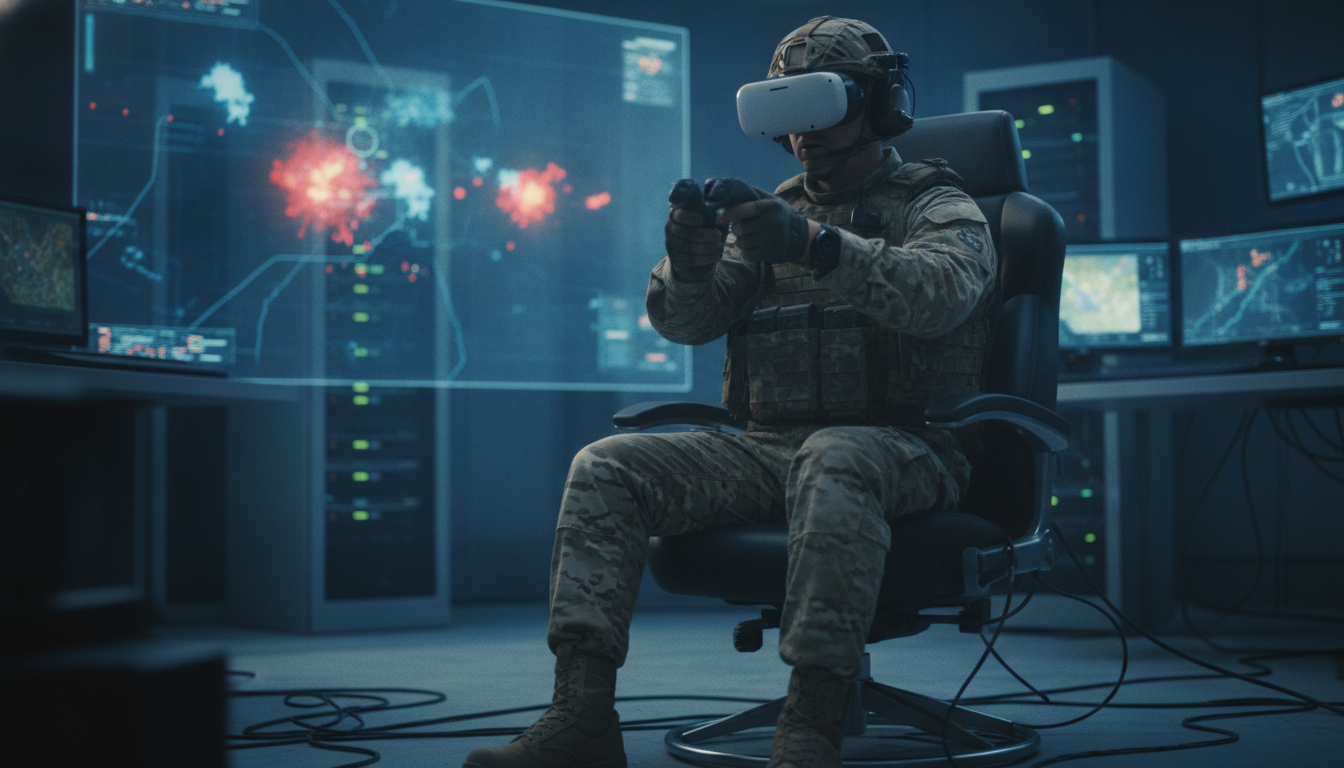
U.S. Army's $26 Billion AI Training Investment by 2028
The U.S. Army plans to invest over $26 billion annually in gamification and simulation training by 2028, IDGA projects. Transfer learning allows AI models trained in structured gaming environments to be adapted for real-world military applications, accelerating development and reducing costs, according to Meegle and AI for Good. AutoNorms points out that despite these advancements, commercial video game AWS often simplify mechanics, creating "ludonarrative dissonance" where AI weapons are portrayed as threats but made "easy targets" for mass-market appeal. Ludonarrative dissonance describes the conflict between a game's narrative and its gameplay. Game design frequently prioritizes futuristic, flashy AI over existing systems like automated sentry turrets, AutoNorms observes, distorting public understanding of real risks. Calian and Defense Magazine confirm that while AI algorithms in military simulations effectively replicate adaptive tactics through dynamic environments and "red teaming," the Journal of Exercise, Gaming, and Entertainment (JEGE) emphasizes that the transfer of skills from commercial gaming to military contexts requires rigorous validation.
DSTS Uses Virtual Battlespace for Thousands of Soldiers
AI enables simulations to process vast amounts of battlefield data, creating dynamic, real-time environments that mirror combat unpredictability, according to Central Florida Tech Grove and Calian. This capability underpins the military's reliance on commercial video game engines and AI-driven simulations, which provide a cost-effective and scalable path for training future soldiers. AUSA and National Defense Magazine highlight that large-scale systems like the DSTS use the Virtual Battlespace game engine to train thousands of soldiers annually. Meegle explains that transfer learning in gaming AI allows models trained in one scenario to be adapted to another, leading to cost efficiency, faster development cycles, and enhanced scalability. AI for Good points out that video games are ideal for AI training because their structured, repetitive nature allows algorithms to develop much more quickly and at a lower cost than in physical spaces.
VBS3 Dependency Disrupts Standardized Training
AUSA, National Defense Magazine, and the Army Acquisition Support Center (ASC) document the military's heavy dependence on proprietary commercial engines like Bohemia Interactive's VBS3, which serves as the collective engine for systems such as the Engagement Skills Trainer II and the Army's Games for Training program. Proprietary updates can alter core mechanics, disrupting standardized training pipelines and creating inconsistencies across units. While beneficial, this reliance creates a technological dependency that can fragment standardized training and increase vulnerability to software-driven gaps. The Journal of Exercise, Gaming, and Entertainment (JEGE) warns that the transfer of skills from commercial gaming to military contexts is not always straightforward and requires rigorous validation.
Video game AWS training, while building cognitive flexibility, simultaneously desensitizes soldiers to the ethical complexities and error rates of machine-led combat. "The gamification of military training risks trivializing the gravity of warfare and normalizing rapid, algorithm-driven violence," according to the Journal of Exercise, Gaming, and Entertainment (JEGE) and AutoNorms. AutoNorms explains that commercial games often reduce AI difficulty to maintain mass-market appeal, creating ludonarrative dissonance that distorts the understanding of real-world AWS risks and lethality. AutoNorms further observes that this focus on futuristic, flashy AI weapons can overshadow existing, more mundane systems, making real threats seem like distant science fiction. Moreover, AutoNorms points out that the first-person shooter perspective restricts training to individual human-versus-machine combat, rarely encouraging broader strategic considerations or emphasizing the unpredictability and lack of accountability inherent in real AWS.
Arma 3, Battlezone, and VBS3: Key Training Platforms
Major armed forces utilize a range of commercial video games and military simulation platforms for AWS training, including Arma 3, which RAND uses for object-detection algorithm training. The Call of Duty franchise is used for tactical combat scenarios and AI-enabled weaponry, according to the Journal of Exercise, Gaming, and Entertainment (JEGE) and AutoNorms. IDGA documents that historically, the 1980 Battlezone was commissioned by the U.S. Army as the "Bradley Trainer" for gunner targeting, and highlights that America's Army, launched in 2002, served as a virtual recruitment and training tool. CapTech University observes that other games like Full Spectrum Warrior focused on realistic squad-level strategy. AUSA, National Defense Magazine, and the Army Acquisition Support Center (ASC) identify VBS3 as a dedicated military simulation platform, often built on commercial game engines, serving as the collective engine for the Engagement Skills Trainer II and the Army's Games for Training program. AUSA and National Defense Magazine affirm that the DSTS is an immersive system training 30,000 soldiers annually, while National Defense Magazine details that PARASIM provides parachute training simulation. AI for Good explains that these platforms offer significant cost and efficiency advantages, with AI training algorithms developing much faster and at lower cost in game environments than in physical spaces.
Human-Machine Teaming for AI-Driven Systems
The integration of autonomous weapon systems in video games for soldier training suggests a future where soldiers are highly adept at human-machine teaming, possessing enhanced cognitive and sensorimotor skills crucial for operating complex AI-driven systems, according to the Journal of Exercise, Gaming, and Entertainment (JEGE), Latham, Patston, and Tippett in Frontiers in Psychology, and Georgia State University. Researchers from IDGA, Central Florida Tech Grove, Meegle, and AI for Good affirm that this approach offers a scalable and cost-effective method to prepare a large force for the complexities of modern warfare, where AI will play an increasingly central role in decision-making and mission execution. However, this dual impact necessitates a strategic approach that uses the technological benefits of gaming while proactively addressing its inherent risks, ensuring soldiers are both tactically proficient and ethically prepared for the future battlefield.
Comments ()