Palantir's AI Forecasts 2026 Midterms Early
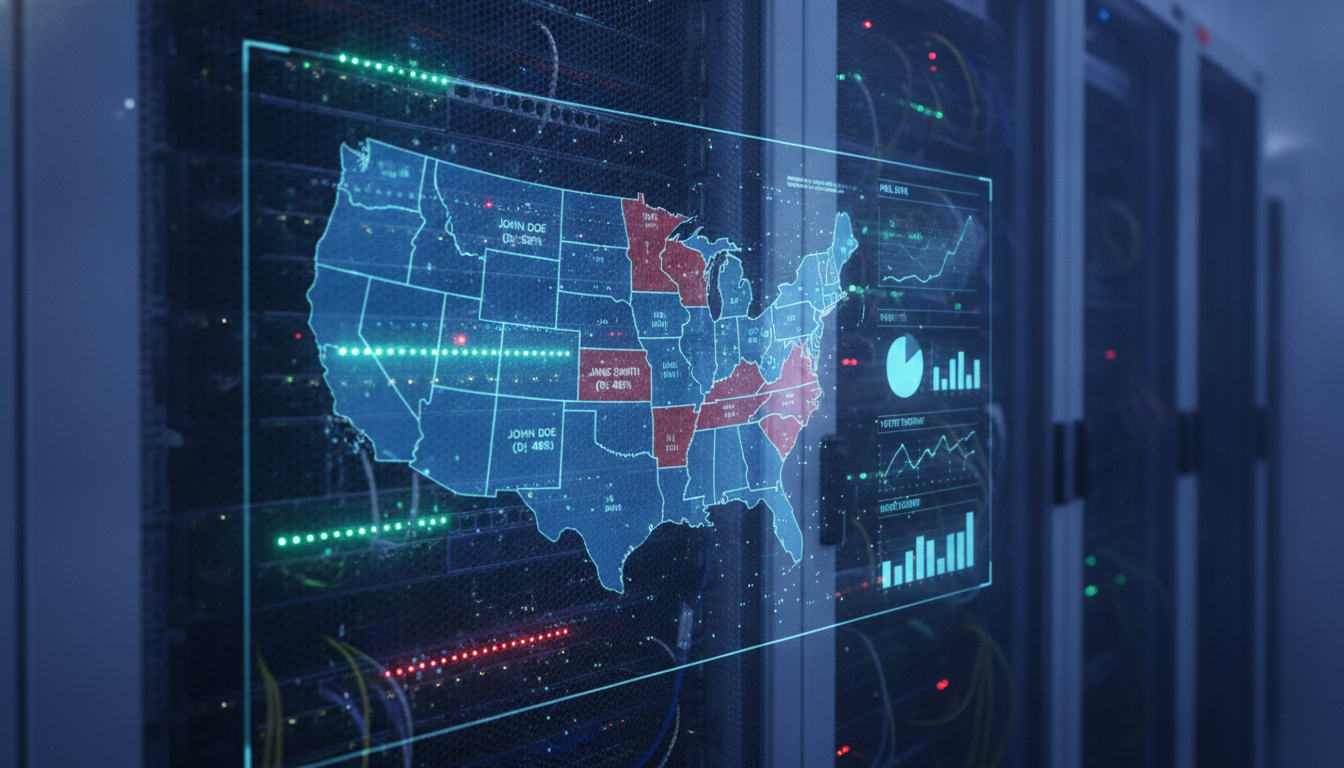
Palantir's Foundry Fused DHS, IRS, SSA Data
Bittnet reported that evidence suggests Palantir's AI predicted the 2026 US midterm election results before polls closed. This was achieved by employing continuous probabilistic modeling that dynamically fused verified early vote counts with real-time social, economic, and psychographic variables. Bittnet and Makena Kelly documented how Palantir's Foundry software fused cross-agency government data from entities like the Department of Homeland Security (DHS), Internal Revenue Service (IRS), and Social Security Administration (SSA) with campaign micro-targeting metrics. Bittnet explained that this analytical engine processes massive volumes of structured and unstructured data to identify patterns and anticipate electoral behavior. The publication observed that the modeling integrates hundreds of social, economic, and psychographic variables, including polls, social media trends, campaign histories, and regional socio-economic indicators, to create a near-real-time picture of electoral dynamics. Bittnet further detailed that as new information arrives, the AI provides real-time predictions, identifies subtle changes in voter perception, and runs thousands of alternative simulation scenarios to adjust its projections.
Early Vote Counts Caused Demographic Blind Spots
Bittnet and POS cautioned that this reliance on historical vote counts introduced systematic demographic blind spots, risking an underestimation of generational shifts or unique voter interest, such as among Democrats. Bittnet and Pennsylvania State University explained that the algorithm assigned higher statistical weight to verified early vote counts and historical turnout patterns, grounding its projections in actual voter behavior. While the AI platform integrated hundreds of social, economic, and psychographic variables to capture daily snapshots of voter perception, Bittnet and Pennsylvania State University emphasized that its core predictive modeling relied on the deterministic nature of early vote counts to establish a high-fidelity baseline. Bittnet concluded that this emphasis on concrete ballot data directly contributed to the algorithm's early accuracy.
Foundry Integrated Disparate Databases
Makena Kelly observed that cross-system queries enabled the linking of disparate databases, processing extensive volumes of social, economic, and psychographic data. Bittnet highlighted that Foundry processes extensive volumes of data, automatically integrating variables from social, economic, and psychographic domains alongside polls, social media trends, and campaign histories. Bittnet determined that this integration allowed the system to run thousands of alternative electoral scenarios, facilitating advanced voter segmentation and high-granularity message tailoring. Bittnet explained that this process improved predictive precision by generating near-real-time models that identified subtle shifts in voter perception and advertisement effectiveness.
Palantir's AI Processed Psychographic Variables Rapidly
Bittnet and Pennsylvania State University emphasized that Palantir's AI gained a forecasting advantage by rapidly processing hundreds of psychographic variables, generating daily snapshots of support trends. Bittnet and Pennsylvania State University further asserted that this computational speed offered a significant edge over the less frequent data points from traditional polls. Bittnet warned that this velocity also made the AI susceptible to artificial fluctuations in the digital space, which could distort pre-close projections if algorithms over-indexed on volatile social signals. To mitigate this, Bittnet explained, Palantir's algorithm prioritized verified early vote counts as a deterministic baseline, using psychographic variables to refine projections rather than exclusively drive them.
Palantir's Ties Influence Elections, AI Regulation
WXOW and Multinationales indicate that the financial and political ties between Palantir and political figures, alongside its advocacy for AI-friendly policies, exert a significant and growing influence on the future of elections and AI regulation. Palantir's proven ability to forecast election outcomes before polls close, by fusing diverse data streams, reshapes how political campaigns operate. Makena Kelly suggests that the expanded use of Foundry software across government agencies points to a growing reliance on advanced data analytics for functions beyond elections. However, Bittnet and Makena Kelly highlighted that this integration amplifies concerns about potential historical biases and indirect manipulation within the electoral process.



Comments ()