Private Control Replaces Public Oversight
TikTok's Algorithm Radicalizes in Three Hours
TikTok's algorithm can politically radicalize a user in under three hours based on engaging with just 450 short videos, the Berkeley Fung Institute found. Brookings details how algorithms function as critical infrastructure, unilaterally structuring public debate and access to information. The Berkeley Fung Institute revealed that internal studies showed Facebook's recommendation algorithms, specifically the "Groups You Should Join" feature and "Discover" page algorithms, contributed to 64% of all extremist group joins. Georgetown Law explains that by determining what billions of people see, read, and discuss, these platforms exercise immense economic and informational power.
Shareholder Value Conflicts with Democracy
The conventional corporate purpose of maximizing shareholder value fundamentally conflicts with the democratic functions these platforms now serve, argues Ugur Aytac in Philosophy & Technology. Georgetown Law notes that corporate executives are accountable to shareholders, not the public, which leads to rule-making that prioritizes engagement metrics and rent extraction over egalitarian public sphere maintenance. A Columbia Law School analysis points out that network effects and high switching costs create a "hostage taking" scenario, trapping users with non-transferrable social capital and leaving them with no credible exit options to exert influence. Ugur Aytac asserts that citizens, as the primary risk-bearing group for an anti-democratic public sphere, lack adequate representation in corporate decision-making. The Austrian Institute for International Affairs explains that the resulting opacity blurs the line between administrative efficiency and democratic legitimacy, because algorithmic systems are technically intricate and difficult for oversight agencies to audit or replicate. Brookings observes that opaque algorithmic choices, such as optimizing for engagement metrics that correlate with outrage rather than deliberation, represent unaccountable exercises of economic and informational power.
Brazil's Pix Offers a Public Model
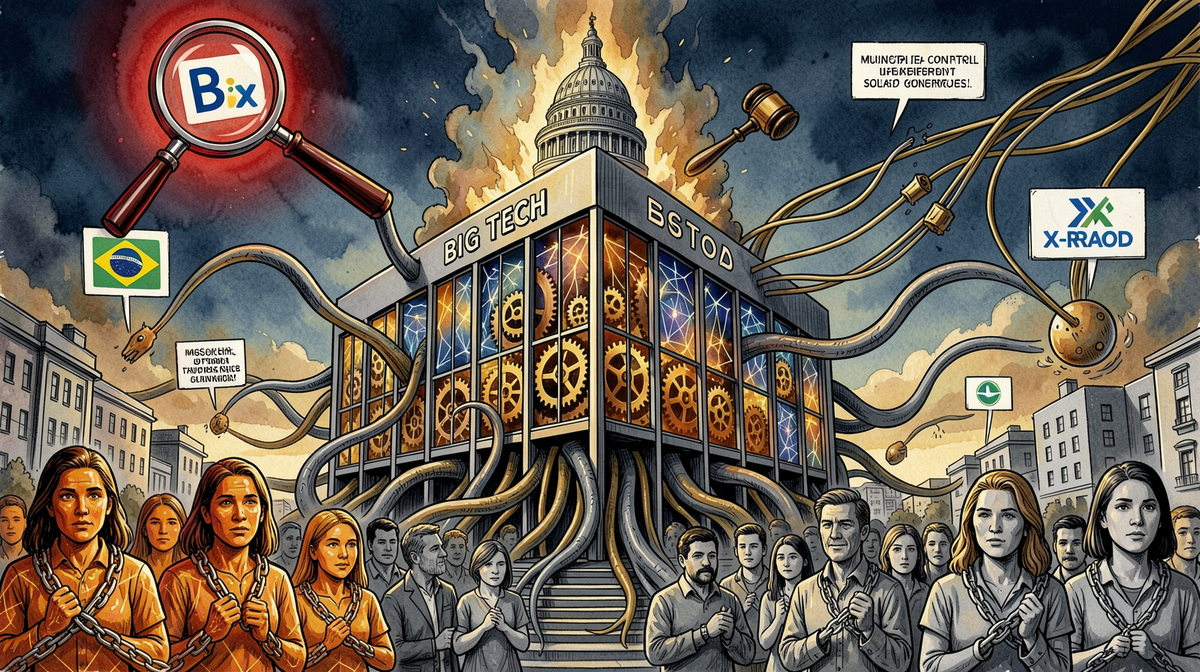
Brazil's Pix, for instance, is a government-owned network run by the Central Bank of Brazil that mandates bank connections and sets zero fees for person-to-person transactions, the Information Technology Industry Council notes. The Democracy Collaborative highlights that municipal broadband pilots and public digital infrastructure initiatives demonstrate state oversight can successfully constrain Big Tech, especially when it moves beyond regulation to build public alternatives. The Counterbalance documents how successful international initiatives like India Stack, Brazil's Pix, and Estonia's X-Road demonstrate that states can escape Big Tech domination by establishing democratically governed digital infrastructure. The UK's proposal to deliver a nationwide full-fiber network by 2030 through public ownership further shows how treating digital connectivity as a public good can restructure the balance of power, The Democracy Collaborative explains. Georgetown Law indicates that post-2023 antitrust litigation trends, such as the FTC's 2020 lawsuit against Facebook for illegal monopolization related to the acquisitions of Instagram and WhatsApp, reveal a struggle between structural constraint and corporate resilience. A Columbia Law School analysis suggests that some scholars argue contemporary antitrust doctrine is insufficient because it overlooks harms to public discourse and democratic accountability. Conversely, the Information Technology and Innovation Foundation contends that focusing on market share or breaking up companies could stifle innovation.
Fiduciary Duty Shift Alone Insufficient
However, mandating this shift alone may not fully rebalance executive authority toward the citizenry, Ugur Aytac warns. Legally redefining corporate fiduciary duties for critical digital infrastructure from shareholder maximization to democratic public-interest preservation is necessary, Ugur Aytac argues. Ugur Aytac highlights that the conventional corporate purpose of maximizing shareholder value fundamentally conflicts with the democratic functions these platforms perform, and citizens are the primary risk-bearing group for an anti-democratic public sphere. Without transforming the internal structure of Big Tech companies to directly represent the entire democratic citizenry, mere regulation or a change in fiduciary duty will fail to contain their political power effectively, Ugur Aytac concludes. Ugur Aytac also notes that regulatory schemes are vulnerable to "regulatory capture" by corporate lobbying.
The Hollowing Out of the State
Decisions affecting public discourse, information access, and economic opportunity are increasingly made by unelected executives whose primary accountability is to shareholders, not citizens, according to the Austrian Institute for International Affairs. This shift, which involves the consolidation of public infrastructure functions within Big Tech platforms, suggests a systemic "hollowing out of the state," where core executive functions are increasingly performed by private entities. The resulting opacity and lack of citizen representation in these critical digital infrastructures pose a significant challenge to the principles of democratic accountability and citizen autonomy.



Comments ()