AMD Narrows AI Chip Gap for Large Models
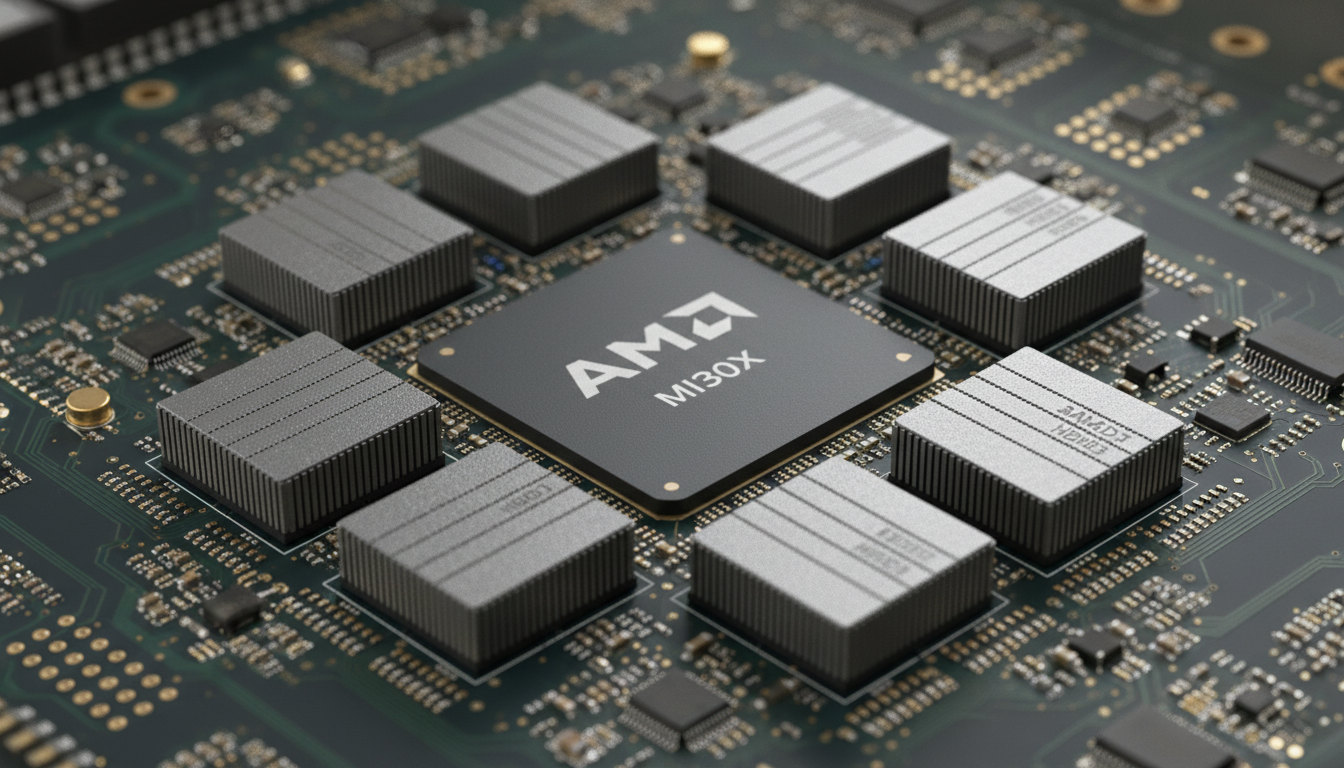
MI355X Narrows H100 Gap on 100B+ Models
Spheron Network found that on the 671B-parameter DeepSeek R1 model, the MI355X achieves approximately 4,200 tokens/sec compared to the H100's approximately 4,500 tokens/sec. Spheron Network also determined that at higher batch sizes, typically 64-128 for high-throughput serving, the throughput gap between the AMD MI355X and NVIDIA H100 shrinks to 5-10% for PyTorch and vLLM workloads. PyTorch is an open-source machine learning framework, and vLLM is a high-throughput serving engine for large language models. Silicon Analysts observe that "Meta runs 100% of its live Llama 3.1 405B inference on AMD MI300X hardware, demonstrating production-level parity." Silicon Analysts, Spheron Network, and RunPod explain that the latency gap also narrows for models over 100 billion parameters because memory-bound inference favors AMD's higher per-chip VRAM, reducing inter-GPU communication overhead. Shashikant Ilager states that the decode phase, largely insensitive to GPU frequency scaling, further allows for lower frequencies to achieve better energy efficiency and higher tokens per joule.
ROCm 7.0 Delivers 3.5x Inference Gains
Silicon Analysts found that ROCm 7.0 delivered up to 3.5 times inference performance improvements over ROCm 6.0. ROCm 7.0 compiler optimizations and open-source tooling contribute directly to this narrowing performance gap for large models. arXiv documents that specific ROCm software components, like hipBLASLt and TensileLite tuning, provide optimized General Matrix Multiply (GEMM) operations and generate tailored GEMM kernels, delivering significant speedups. hipBLASLt is a library for optimized GEMM operations, and TensileLite is a tuning framework for GEMM kernels. Silicon Analysts explain that PyTorch TunableOp automatically selects the best-performing kernels from rocBLAS, AMD's Basic Linear Algebra Subprograms library, and hipBLASLt. Silicon Analysts and TensorWave detail that Flash Attention 2 reduces memory movements, while vLLM uses specialized AMD AITER primitives, such as ROCM_AITER_FA, for Multi-Head Attention. ROCm documentation indicates that AITER, or AMD Inference Tensor Engine Runtime, uses highly optimized kernels and hardware-optimized Key-Value (KV) cache layouts to deliver 2.7-4.4x higher throughput than legacy backends. AI-Crucible describes Fleet, a persistent kernel runtime, as avoiding separate kernel launches per operator by launching a single kernel for the computation's lifetime, thereby delivering deterministic latency across batch sizes.
H100's 31.9% Latency Lead Over MI300X
AIMultiple determined that in an 8-GPU configuration, the H100 delivers 31.9% lower latency than the MI300X. Silicon Analysts and AIMultiple attribute NVIDIA's compounding efficiency gains in multi-node training to its superior software maturity, interconnect technology, and higher effective GPU utilization, despite AMD's advances in large model inference. Spheron Network observed that for models under 100 billion parameters and low batch sizes (1-4), the NVIDIA H100 maintains a 20-30% throughput advantage. Silicon Analysts point out that multi-node training scenarios see the H100 outperform the MI300X by 10-25%, with this gap expanding as scale increases. AIMultiple's benchmarks reveal NVIDIA's lead growing from 29.4% higher throughput on 2 GPUs to 46% higher on 8 GPUs in multi-GPU throughput tests.
MI300X's 45% Utilization Narrows TCO Advantage
Silicon Analysts observed that the AMD MI300X boasts a 32% theoretical Floating Point Operations Per Second (FLOPS) advantage over the NVIDIA H100, but achieves only about 45% utilization in microbenchmarks compared to NVIDIA's 93%. Silicon Analysts determined that this lower effective utilization creates a theoretical overhead of approximately 107% in training time and energy consumption, translating to 10-25% slower training time for AMD hardware in real-world multi-node training workloads. While AMD GPUs may have a lower upfront hardware cost, Silicon Analysts estimate that the combination of lower software utilization and increased engineering overhead narrows the effective Total Cost of Ownership (TCO) advantage for training workloads to 15-25%. However, Silicon Analysts, Spheron Network, and RunPod highlight that for memory-bound inference, the efficiency gains from AMD's HBM capacity and targeted optimizations make it highly competitive in FLOPS/watt and latency. arXiv and RunPod indicate that quantization techniques can also reduce energy consumption by 50-62%, altering FLOPS/watt efficiency.
ROCm Becomes Viable for Memory-Bound Inference
Silicon Analysts suggest that the narrowing performance gap for large foundational model inference could lead to increased adoption of AMD hardware in cloud and enterprise environments for serving large language models, potentially diversifying the AI accelerator market. Organizations must now carefully evaluate their specific workload requirements, whether compute-heavy training or memory-heavy inference, to determine the most cost-effective and performant hardware and software stack.

Comments ()