NVIDIA's AI Stack Centralizes Global Infrastructure
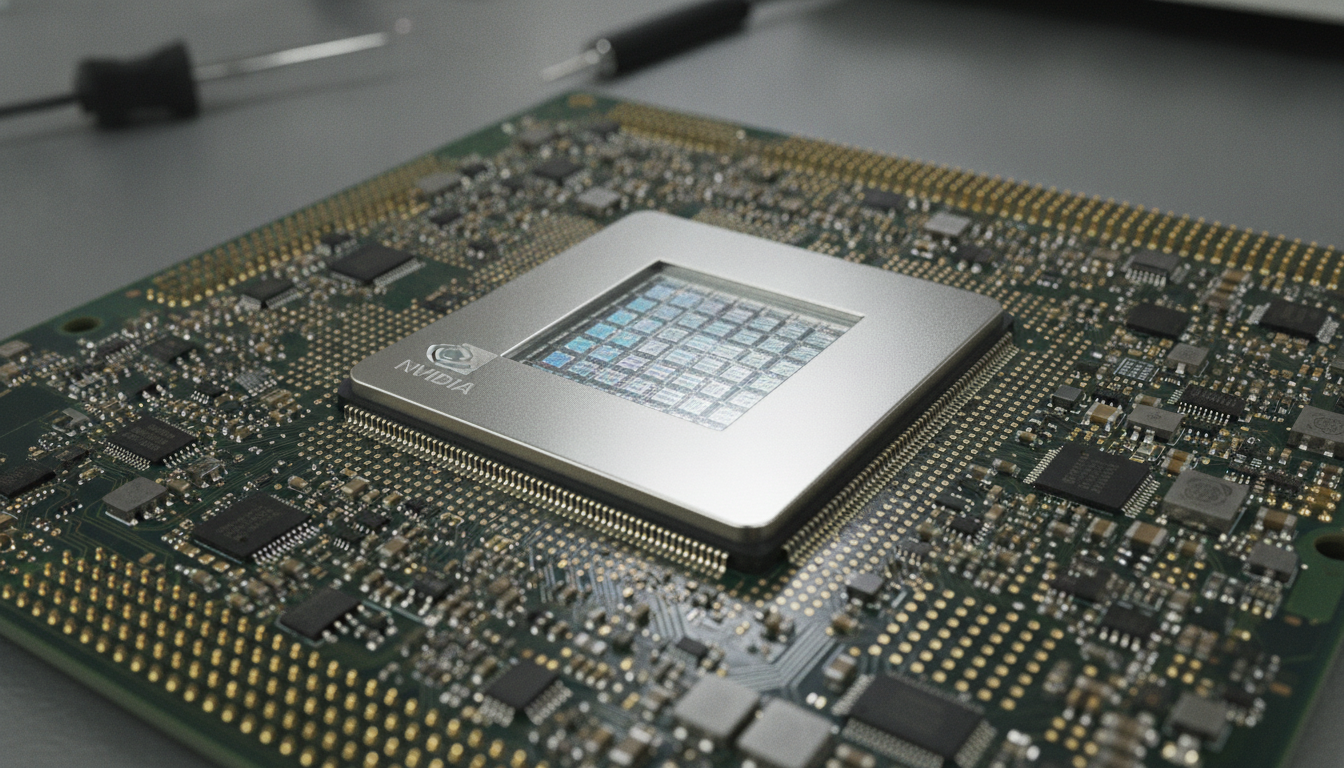
NVIDIA's Ecosystem and iFlytek's Delay
Migrating from CUDA to alternative ecosystems, such as AMD's ROCm open-source software platform for GPU computing, requires months of engineering effort and hundreds of thousands of dollars per project. RAND reported that Chinese AI firm iFlytek experienced a three-month development delay when migrating from NVIDIA to Huawei chips. CNBC and Coingeek reported that NVIDIA opened a research hub in Singapore in May 2026 and plans a $200 million AI center in Indonesia. Kristal.ai, the Times of India, and Chipstrat explained that NVIDIA's vertical integration, which combines silicon, systems, and software, provides a structural competitive advantage that cannot be replicated by simply building faster chips. Tilburg University detailed that deploying Blackwell GPU-certified data centers—facilities validated to run NVIDIA's latest generation of graphics processing units—and Blackwell-optimized blueprints for 250MW-scale clusters, such as those in a planned 5GW UAE-US AI Campus in Abu Dhabi, mandate Blackwell-certified infrastructure and rely on proprietary NVLink interconnects, NVIDIA's high-speed, point-to-point connection for GPUs, and InfiniBand networking, a high-throughput, low-latency communication standard.
NVIDIA's MENA Data Centers Anchor Abu Dhabi
Partnerships in the Middle East and North Africa (MENA) region, such as those with Khazna and Ooredoo, involve deploying Blackwell GPU-certified data centers, anchoring the Abu Dhabi campus, Tilburg University and Coingeek found. The U.S. CHIPS and Science Act, which allocates $39 billion for domestic manufacturing and a total investment of $52 billion, drives geographic redistribution of semiconductor manufacturing. Brookings and Traxtech reported that TSMC is establishing plants in Arizona, and Intel is investing in Ohio. US-Taiwan.org also noted that TSMC has built factories in Japan. However, Tilburg University observed that this geographic diversification often replicates a monolithic, NVIDIA-centric operational model rather than fostering open standards.
China's 50% Energy Discount and AI Funds
CSIS and RAND reported that China creates a structural competitive advantage by discounting energy costs for chip companies by 50%. The energy-intensive scaling of AI factories forces national governance structures to prioritize compute infrastructure over traditional power allocation. Jensen Huang describes AI as a "five-layer cake" where energy is the foundational layer, with AI factories reaching gigawatt scale and costing $50–60 billion each, according to the Milken Institute and CSIS. RAND found that China's industrial policy, which aims for global AI leadership by 2030, is supported by an $8.2 billion National AI Industry Investment Fund and a $138 billion National Venture Capital Guidance Fund targeting AI fields. RAND also added that the Bank of China has committed $138 billion in financing for AI industries. China added 429 GW of net new power generation capacity in 2024, more than 15 times the U.S. capacity added in the same period, RAND reported. Despite these efforts, RAND noted that only two of 321 notable AI models are trained on domestic Chinese hardware.
U.S. Controls Spur Huawei Ascend Chips
U.S. export controls have constrained China's access to advanced computing power and delayed the mass production of domestic AI chips by years, according to the USCC, Congress.gov, and Brookings. Stratechery reported that Jensen Huang argues these controls are "counterproductive," conceding the second-largest AI market to competitors and forcing China to build its own ecosystems. US-Taiwan.org, RAND, and Brookings noted that competitors like Huawei are developing Ascend 910B and 910C chips, its series of AI processors, while Intel is expanding capacity with a $20 billion investment in Ohio. RAND also found that Chinese domestic firms like Moore Threads and Denglin Technology are building hardware and software alternatives. CSIS and RAND reported that China's semiconductor industry has doubled its annual growth, outpacing the 20-30% growth rate in the West, partly by drawing on state subsidies and energy cost discounts. However, GAO and ITEA found that U.S. federal policies actively prioritize preventing vendor lock-in and fostering competition.
NVIDIA's Architecture and Vendor Dependency
Global AI infrastructure, despite its geographic spread, is increasingly anchored to NVIDIA's proprietary full-stack architecture. This trajectory presents a dilemma for nations: rapid AI development through NVIDIA's integrated solutions comes with the trade-off of heightened vendor dependency and reduced agility. The evidence suggests that even state-led efforts to build domestic manufacturing capacity are often absorbed into these proprietary frameworks, reinforcing a single dominant standard.


Comments ()