Kyiv Centralizes Power as Oligarchs Fall
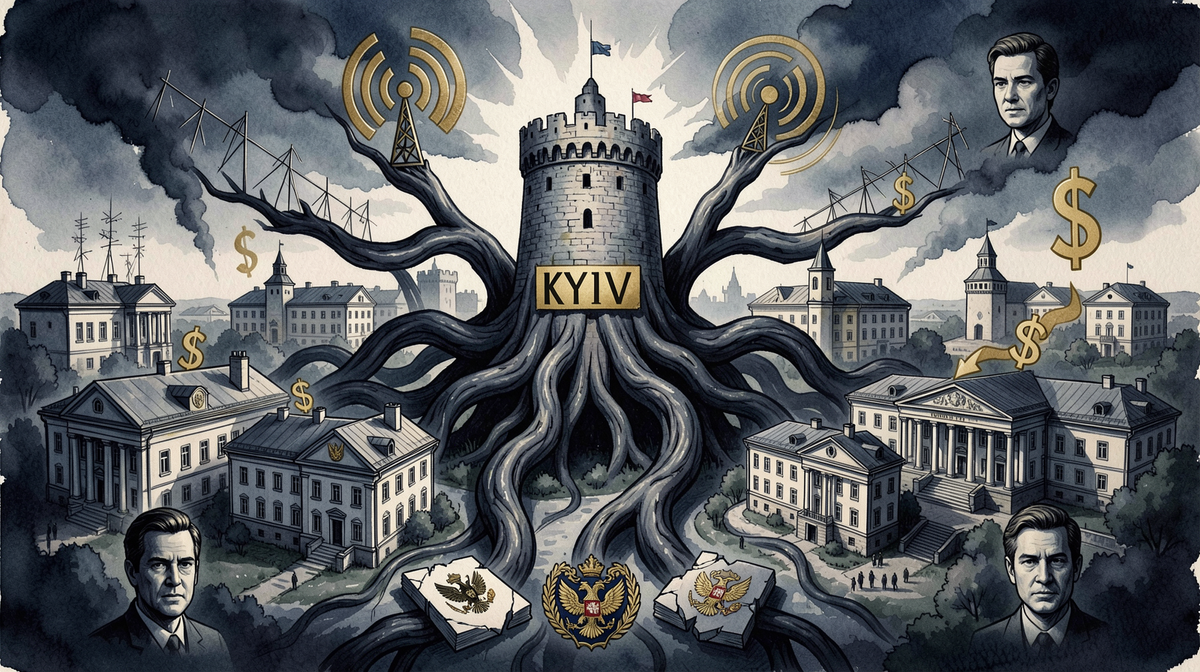
Military Administrations Gain Authority in 214 Municipalities
The LSE Public Policy Review found that as of December 2025, military administrations gained authority in 214 municipalities to transfer funds from local budgets to the armed forces and manage municipal property, shifting decision-making from elected local bodies to a single military administrator. The Carnegie Endowment also documented that small towns saw their revenues collapse by as much as 45% in 2024, while regional governments experienced a 26% drop in own-source revenues alongside a 25% decline in state transfers. Financial transfers from the central government to major cities increased by 48% since 2022, further solidifying Kyiv's financial leverage. Conversely, PONARS Eurasia documented that western Ukrainian oblasts like Lviv, Zakarpattia, and Volyn experienced general fund revenue increases of more than 30% in 2022. A peer-reviewed study in ScienceDirect reported that by 2025, Lviv, Ivano-Frankivsk, and Ternopil oblasts recorded the fastest municipal revenue growth, at 18-21%.
Centralized Technocratic Channels Manage $92.5 Billion
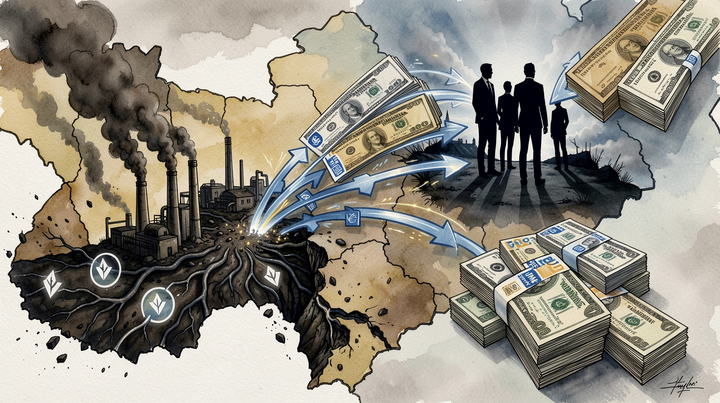
The IJES Journal indicates that international donor funds for Ukraine's reconstruction, projected to reach $92.5 billion for the 2025-2027 period with $74.6 billion structured as loans, are managed through centralized technocratic channels. Politika a Společnost observed that this immense funding, estimated at $486 billion under the RDNA3 framework, creates new avenues for politically connected business interests, favoring urban technocratic circles over broad-based provincial development. CIRSD and a peer-reviewed study in ScienceDirect highlight Ukraine's significant reserves of critical minerals, including graphite, lithium, titanium, and rare earth elements. International Viewpoint suggests, however, that international donor conditionalities on reconstruction loans are expected to override regional resource claims in favor of centralized technocratic management.
2025 Reverse Grants Reinstated for 189 Communities
VoxUkraine reported that in 2025, the government reinstated reverse grants, requiring 189 territorial community budgets and 6 regional budgets to contribute UAH 14.9 billion to the state budget, thereby partially overriding temporary wartime fiscal autonomy. Between 2023 and 2025, specific legislative amendments and cabinet decrees formally centralized provincial budgetary control, reversing pre-war decentralization reforms. Ukraine's Ministry of Development confirmed that public investment management reforms, including a law passed on January 16, 2025, mandated local plans comply with the state development strategy. The LSE Public Policy Review also observed that the Verkhovna Rada approved changes to the 2025 state budget, redirecting Hr.8 billion ($198.3 million) in bank profit tax revenues from Kyiv's local budget directly to the state budget's general fund.
Unified National TV News Consolidates Broadcasters
CEPA reported that a unified national television news operation was introduced, consolidating many of the country’s broadcasters and limiting the ability of provincial oligarchs and factions to shape independent political narratives. International Viewpoint found that while 60% of Ukrainians consider it unacceptable to transfer control of all of Donbas to Russia, martial law and centralized mechanisms largely neutralize this sentiment. The CEPA article asserts, "The war also weakened the oligarchs’ media power" and "Kyiv introduced a unified national TV news operation... which consolidated many of the country’s broadcasters, and limited the ability of competing oligarch-owned channels to shape political narratives." The Carnegie Endowment concluded that wartime fiscal centralization has severely undermined the financial autonomy required for sustained provincial defiance.
Kyiv's Urban Technocrats Wield Substantial Power
Kyiv's urban technocrats, backed by international donors, will wield substantial power through their control over reconstruction financing and administrative levers, likely leading to policies prioritizing privatization and foreign investment. The evidence points to a durable shift in Ukraine's domestic political situation towards a more centralized, technocratic model. CEPA warned that this dynamic, while weakening traditional provincial oligarchs, risks reproducing patronage patterns within a centralized framework, as new elite networks emerge from the defense-industrial and reconstruction sectors.

Comments ()