Ukraine's Economic Cession Deepens Western Reliance
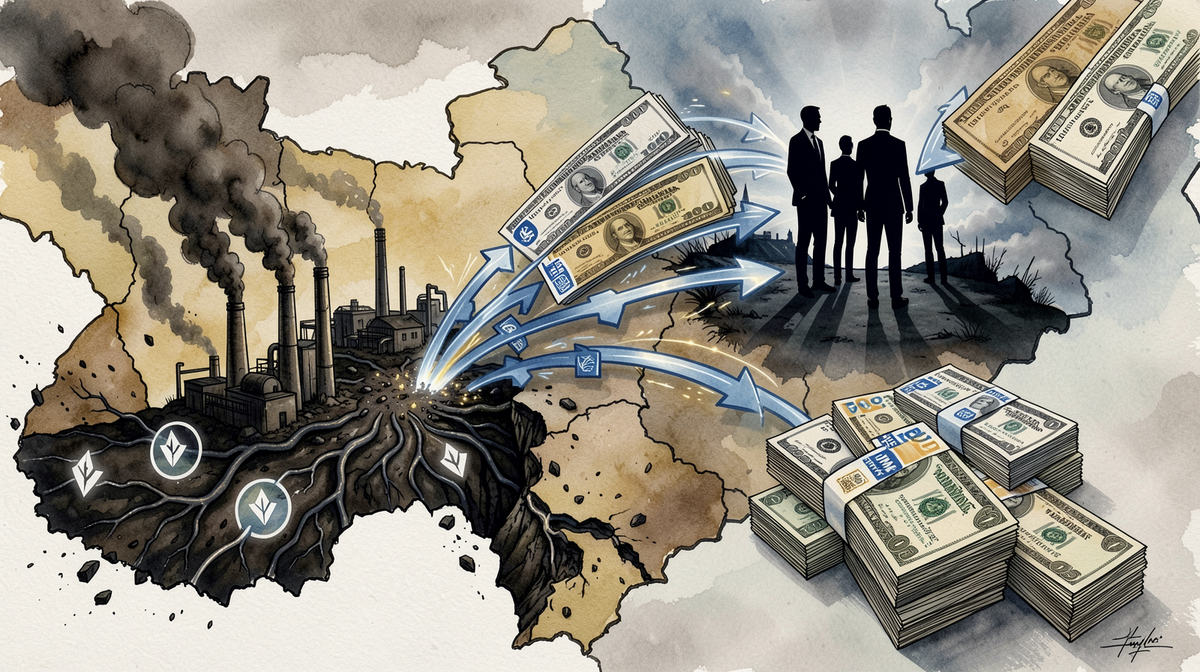
The Vienna Institute for International Economic Studies and PONARS Eurasia contend that the industrial Donbas, a region with steel capacity cut by 80% and an estimated $21.7 billion in reconstruction costs even before the 2022 invasion, represented a chronic fiscal drain.
Kyiv's 48% Increase in City Transfers
Carnegie Endowment found that fiscal centralization has empowered Kyiv’s technocratic coalition, as regional governments experienced a 26% drop in local source revenues and a 25% decline in state transfers, while financial transfers from the center to cities increased by 48% since 2022. ECFR reported that the government has actively consolidated this power by clashing with and removing mayors in areas where its ruling party did not win local elections, explicitly targeting local clan networks. Both ECFR and CEPA observe that this shift has eroded traditional provincial oligarchic power bases, replacing them with new elites tied to the presidential administration and security services.
19,000 Companies Relocated West After 2022
Carnegie Endowment documented that nearly 19,000 companies relocated their legal addresses to western oblasts after 2022. The war destroyed or suspended 70% of large enterprises in Kharkiv Oblast and caused a 70% drop in sales across eastern Ukraine, a trend Carnegie Endowment identified. This decimation of eastern economic activity has driven a fiscal decoupling of western Ukraine, structurally empowering Kyiv’s technocratic coalition to bypass traditional provincial patronage networks. Carnegie Endowment reported that western regions like Lviv and Zakarpattia have absorbed displaced human capital and economic activity, with Lviv seeing a 23% increase in job vacancies and Zakarpattia a 55% surge by early 2024. Both Carnegie Endowment and ECFR observed that this fiscal gravity, combined with the redirection of the military tax to the central budget in 2023, further weakened provincial factions and enabled Kyiv to sideline smaller communities.
2023 Military Tax Redirection Weakens Local Finances
Carnegie Endowment highlighted that the redirection of the military tax to the central budget in 2023 further weakened community finances. The post-2014 decentralization reforms have been significantly undermined by wartime fiscal centralization, making provincial autonomy structurally fragile under centralized reconstruction financing. Carnegie Endowment determined that regional governments experienced a 26% drop in local source revenues and a 25% decline in state transfers, while financial transfers from the center to cities increased by 48% since 2022. Carnegie Endowment cautions that this erosion of local institutional capacity and shrinking service networks deepens financial dependency on Kyiv, risking the sidelining of smaller communities that were the core beneficiaries of decentralization.
Loss of Minerals Forces Donor Frameworks
As CIRSD reported, "Russia now controls over $12.5 trillion worth of Ukrainian mineral and gas assets in these occupied provinces, including 56% of hard coal reserves and 50-100% of critical minerals like lithium, tantalum, and uranium." The ceding of the industrial Donbas allows Kyiv to reallocate resources to more stable, service-based economies in western and central Ukraine, but this consolidation comes at the expense of Ukraine's independent economic foundations. International Viewpoint and CIRSD warned that this loss of critical minerals forces Kyiv to accept donor-driven reconstruction frameworks that prioritize privatization, fiscal austerity, and labor deregulation, thereby constraining the technocrats' ability to dictate domestic economic policy independently. Carnegie Endowment, PONARS Eurasia, Tony Wood, and Crisis Group all concur that the ceding of the industrial Donbas allows Kyiv to reallocate resources to more stable, service-based economies in western and central Ukraine, accelerating the erosion of decentralization and reinforcing a centralized, urban technocratic coalition.
Ceding East Deepens Western Reliance
The loss of critical mineral and industrial export capacity would deepen Kyiv's reliance on Western financial support and conditionalities, potentially creating a brittle state managing a fragmented economy; indeed, evidence indicates that a peace deal ceding eastern territories would solidify Kyiv’s technocratic coalition through fiscal control, but at a profound cost to Ukraine's economic sovereignty. This dynamic risks alienating depopulated eastern provincial representatives, who would become increasingly dependent on central grants, potentially leading to future fragmentation if their needs are not adequately addressed within the centralized framework.

Comments ()