Space Barons: The Final Frontier
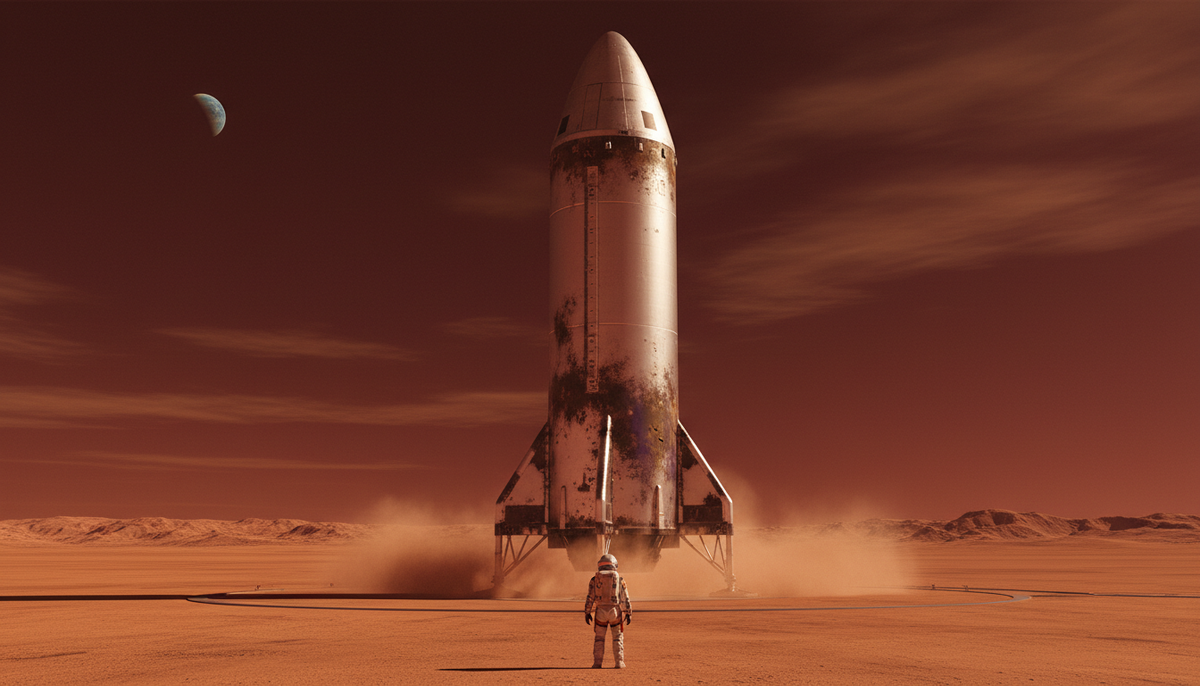
Billionaires construct spaceships to realize ambitious, long-term visions for humanity's future in space. These projects also drive new industrial enterprises and consolidate wealth in the burgeoning space economy. Elon Musk, through SpaceX, aims to establish a self-sustaining Mars colony. He believes it is crucial for humanity's long-term survival. Jeff Bezos, with Blue Origin, envisions large-scale space industrialization. His goal is off-Earth resource utilization and housing trillions in orbital colonies.
These ventures involve high-risk, iterative technological innovation. They seek market dominance. The global space economy, valued at $613 billion in 2024, could reach $1.8 trillion by 2035. This private capital influx concentrates wealth, raises questions about equitable access, and presents growing environmental challenges.
The Visionaries' Frontier
These modern titans fund a new kind of exploration. It mirrors ancient empires sending ships to discover new continents, driven by dreams of expansion and resources. A new frontier, for profit and survival.
Elon Musk openly states his motivation. His focus is a self-sustaining Mars colony, a species insurance policy. Jeff Bezos, in contrast, champions orbital industrialization. He envisions manufacturing in space and relocating polluting industries off-Earth. His ultimate goal is to house trillions of people in vast space colonies. Richard Branson's Virgin Galactic initially pursued space tourism. The company has since faced financial difficulties and adjusted its strategy.
The Billion-Dollar Race
This push into space looks much like a gold rush, but in the vacuum beyond Earth. Billions fuel the push beyond Earth. The space economy's growth has been substantial. Private capital now outpaces traditional government funding. Billions flow into private space companies. Jeff Bezos invests over $1 billion annually into Blue Origin. SpaceX has targeted an initial public offering valuation of over $1 trillion. Rocket Lab held a market capitalization of approximately $38.65 billion as of April 9, 2026.
This private funding allows for greater risk-taking than historically seen in government programs. SpaceX focuses on reusable rocket technology, notably the Falcon 9 and Starship. Blue Origin prioritizes reusable launch systems and in-space manufacturing. Both companies, along with others, deploy vast satellite constellations for space-based broadband. In 2025, SpaceX completed 167 orbital flights. This shows an aggressive launch cadence.
Billionaire-backed companies tolerate higher risk than government space agencies. They invest heavily in unproven technologies like fully reusable rockets. They pursue ambitious projects like Martian colonies. This approach embraces iterative development. Failures are part of the process. SpaceX's Starship program exemplifies this. Such risk-taking drives innovation. It has significantly lowered launch costs. A Falcon 9 launch now costs approximately $100 million. The Space Launch System (SLS) costs around $4.1 billion per launch.
Wealth in Orbit, Dirt on Earth
The benefits of this space expansion operate like a velvet rope. It keeps most people on the ground while a select few attend an exclusive party. Space for few, not for the many. Cost reductions from reusable rocket technology and the space economy's growth largely benefit a few private companies. Wealth concentrates among entities like SpaceX and Blue Origin. The commercial focus consolidates wealth among investors and highly skilled workers. Venture capital funding shows systemic biases. All-female teams received only 2.8% of funding in 2019, despite comparable financial returns.
Space tourism, despite initial aspirations for broader access, remains an exclusive market. Costs are prohibitively high, around $55 million per suborbital seat. Scalable demand is limited over the next decade. Commercial space risks worsening existing economic inequalities. Resource-dependent developing nations may suffer. Widespread asteroid mining of resources like platinum could devalue terrestrial markets. Asteroids like 16 Psyche could hold resources valued up to $700 quintillion. Current legal frameworks contribute to wealth concentration due to limited regulation and ambiguous space resource ownership.
The Environmental Footprint
Each launch, a whisper of smoke in a pristine gallery. Earth pays for our dreams of space. Private space ventures contribute to atmospheric emissions and space debris. The industry's rapid growth projects 400 to 884 annual launches by 2030. This means increased emissions. Rocket exhaust releases water vapor, carbon dioxide, nitrogen oxides, black carbon, and chlorine. Eloise Marais, an atmospheric scientist, points out that these processes inject pollutants into nearly every atmospheric layer.
These emissions pose risks to the ozone layer. Current global ozone depletion from launches remains minimal, less than 0.1%. A tenfold increase in launches could lead to near-global ozone losses of up to 0.15%. Polar regions could see projected ozone losses exceeding 0.5% in the Antarctic and 2% in the Arctic under higher emission scenarios. Black carbon from rocket launches also warms the stratosphere, contributing to climate forcing. A decade of sustained space tourism launches could result in radiative forcing of 8 mW m-2.
The increasing launch frequency creates more space debris. This raises the probability of orbital collisions. It interferes with astronomical observations. On Earth, manufacturing, refurbishment, and disposal processes for reusable rockets may offset per-launch resource savings. Over 90% of launch sites are within areas where unprotected habitats exceed 50%. More than 62% of operating sites are located within or near protected areas, impacting biodiversity. Current atmospheric models lack the detail to accurately predict long-term cumulative effects. Precise measurements of rocket plume composition are scarce.
What We Leave Behind
Billionaires describe grand visions for humanity's future beyond Earth, a new age of abundance in space. Evidence of significant wealth concentration and environmental costs transforms these aspirations. They become a stark accounting of who truly benefits, and at what price.


Comments ()