Ukraine's Digital Procurement Centralizes Wartime Power

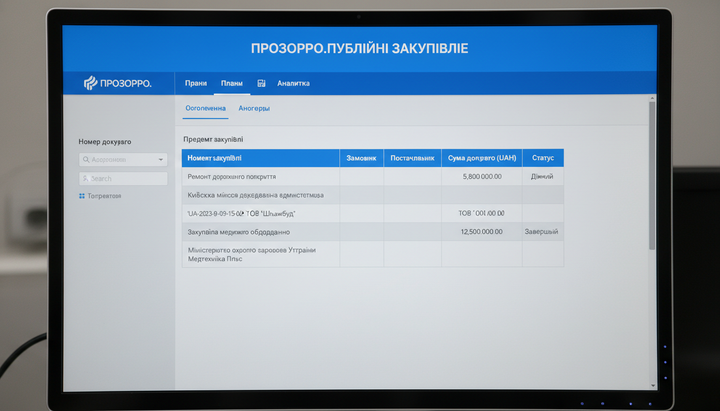
The OECD OPSI and Open Contracting estimated that before the 2014 reforms, Ukraine lost an estimated $2 billion annually from an $11 billion public procurement budget due to corruption and limited competition. ProZorro's open-data architecture increased competitive bidding, with 68% of tenders receiving two or more bidders in 2023, the EBRD found. The Harvard Kennedy School and Transparency International Ukraine documented how ProZorro's "everyone can see everything" principle provides real-time access to tendering data, enabling civic oversight by organizations like Dozorro to flag irregularities. Open Contracting explained that the DREAM ecosystem, coordinating over 5,000 reconstruction projects across 24 regions and more than 500 municipalities, further extends this by embedding smart risk indicators that automatically flag project delays and potential fraud for donors and authorities during wartime reconstruction. This wartime adaptation also reduced drone purchase prices by 30%, the European Commission determined.
Cabinet Resolutions No. 169, No. 1178 Suspend Tenders
Business Perspectives and a policy brief revealed that martial law directives, such as Cabinet Resolutions No. 169 and No. 1178, suspended competitive tenders, allowing officials to prioritize central government loyalty over local needs. Algorithmic transparency in ProZorro and DREAM can mask underlying shifts in political loyalty through threshold manipulation, wartime discretionary awards, and associated party procurement. A policy brief observed that local amalgamated hromadas, or communities, frequently use direct selection for contracts below UAH 50,000, bypassing competition to favor local companies and build informal loyalty. Informal mechanisms, such as companies controlled by a single owner "competing" to win predetermined contracts at inflated prices, further mask loyalty, MSI Worldwide documented. A peer-reviewed study identified vertical shadow funding schemes that channel public funds to political proxies through discretionary contract awards.
Over 20 Amendments Increase Discretionary Awards
The German Marshall Fund of the United States and a peer-reviewed study reported that martial law suspensions introduced over 20 amendments to procurement laws, increasing discretionary contract awards and causing notable setbacks in public transparency. These hidden alignments inflate contract prices, drain municipal resources, and centralize administrative control, weakening the fiscal autonomy of local hromadas, according to the Harvard Kennedy School, the Center for Global Development, and Open Contracting. A policy brief determined that planning-stage opacity leaves initial project design and final contract execution largely outside digital oversight. The Harvard Kennedy School and BTI Project warned that the postponement of elections under martial law removes periodic democratic mandates, allowing procurement-driven selection to entrench clientelism and erode institutional trust.
UAH 30 Million Annual Budget Loss
A December 2024 CEUR-WS.org study revealed inaccurate and incomplete data at the planning and contract stages of ProZorro, leading to an estimated annual budget loss of approximately UAH 30 million (around US$820,000) due to reporting overlaps. While specific audit reports from 2024–2026 quantifying the market share of winning bids by Zelensky-aligned oligarchs or regional governors are not publicly available, several investigative findings document procurement anomalies. A March 2026 Transparency International Ukraine report indicated that over 55% of checked hard coal procurements contained unlawful requirements and extremely stringent conditions. A December 2025 Transparency International Ukraine study identified widespread procurement contracts with abnormally long payment terms. The OECD's "Ukraine Fifth Round of Anti-Corruption Monitoring Follow-Up Report," approved in July 2025, rated Ukraine's public procurement integrity as "high," incorporating data on 2024 court decisions regarding conflicts of interest. Ukraine's Ministry of Economy reported that the Prozorro Awards 2024 recognized an investigation into inflated school textbook prices.
Sub-threshold Contracts, Suspensions Mask Patronage
A policy brief, the German Marshall Fund of the United States, and EU-RESPOND found that the systems create structural dependencies and vulnerabilities through loopholes, such as sub-threshold direct contracts and wartime transparency suspensions, which can mask localized patronage and centralize control. Ukraine's e-procurement systems, ProZorro and DREAM, establish a resilient governance layer that enforces accountability and drives efficiency, yet they cannot fully substitute for the direct political mandate of competitive elections. PTFund and Transparency International Ukraine observed that the integration of civic watchdogs like Dozorro and the RISE Ukraine Coalition actively engages civil society, preventing the normalization of unaccountable power consolidation. The evidence suggests that while these digital tools build a solid foundation for long-term institutional stability, their effectiveness remains contingent on continuous civic oversight to prevent the exploitation of existing loopholes and the consolidation of unaccountable power.
Comments ()