East Asia Forges Middle East Alliances
India-UAE CEPA Drives $100 Billion Trade
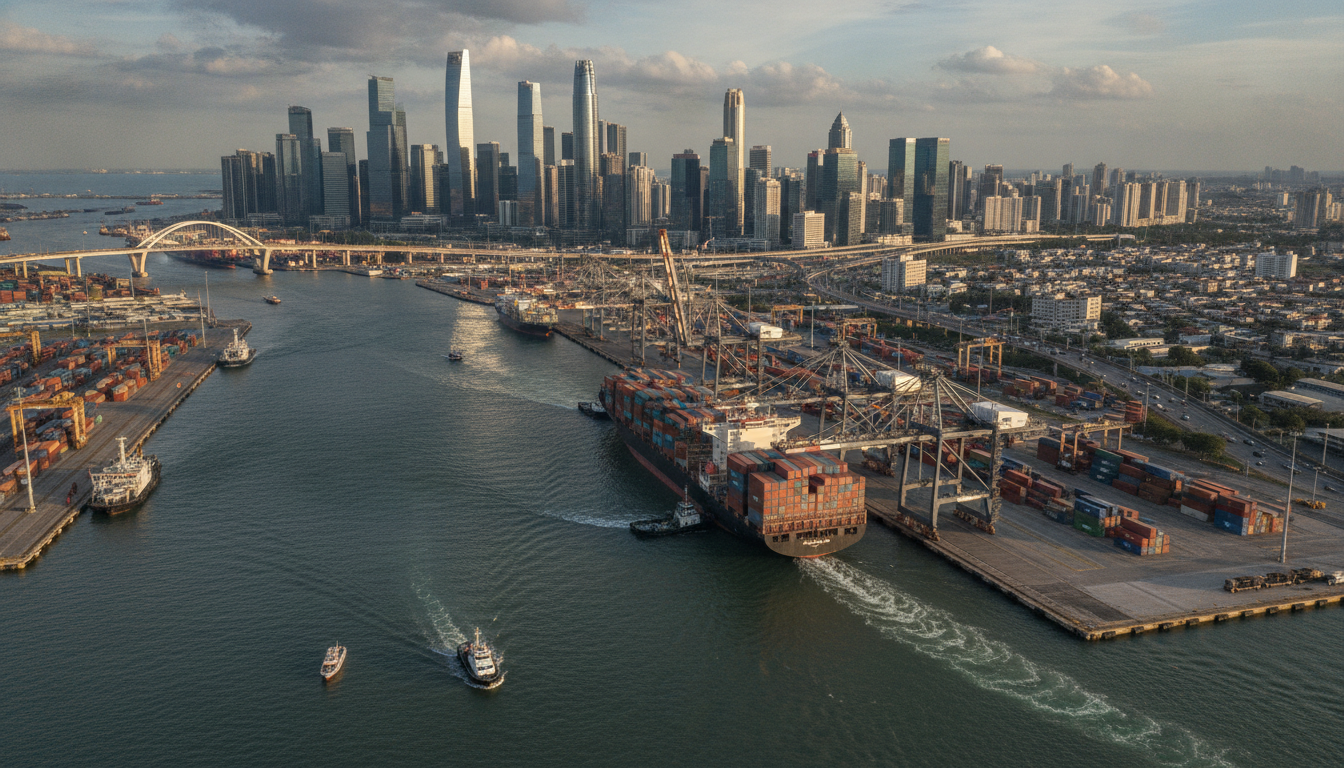
The India-UAE Comprehensive Economic Partnership Agreement (CEPA), active by early 2026, pushed bilateral trade beyond $100 billion. Non-oil trade surged 19.7% to $65 billion in 2025, Asia House reported. India formalized broader regional integration by signing the Terms of Reference for a Free Trade Agreement with the Gulf Cooperation Council (GCC) on February 5, 2026, and launching formal negotiations on February 24, 2026. Cescube explained that this CEPA structurally insulated bilateral trade from dollar volatility by operationalizing a local currency settlement system (rupee-dirham) and integrating the Unified Payments Interface (UPI). GRC documented the finalization of a comprehensive trade agreement with Oman in December 2025. GTR Review observed that while the India-Middle East-Europe Economic Corridor (IMEC) faced headwinds with its Northern Corridor deemed non-viable due to regional conflicts, India utilized alternative ocean-air transport routes, such as Maersk shipping goods to Dubai and then to European airports.
Vietnam's $15.2 Billion FDI in Q1 2026
Incorp Asia announced that total registered Foreign Direct Investment (FDI) in Vietnam reached nearly $15.2 billion in the first quarter of 2026, marking a 42.9% year-on-year increase. By 2026, Vietnam had institutionalized economic liberalization through a network of over 16 active free trade agreements, Incorp Asia found. Asia House and Incorp Asia reported that a Comprehensive Economic Partnership Agreement (CEPA) with the UAE, signed in late October 2024 and entering full force in February 2026, established the UAE as a re-export hub for Middle Eastern markets, driving a 17% increase in UAE-Vietnam trade in the first half of 2025. The Vietnam-Israel Free Trade Agreement (VIFTA), in force in late 2024, reduced tariffs and focused on intellectual property protection and technology transfer for high-tech manufacturing and semiconductors, Incorp Asia highlighted. GTR Review and Incorp Asia cautioned, however, that this hub status depends heavily on FDI and its role as a re-export conduit for "China Plus One" strategies, constraining Vietnam's long-term strategic autonomy.
Gulf-Asia Trade Reaches $516 Billion in 2024
GTR Review documented that Gulf-Asia trade reached $516 billion in 2024, significantly outpacing trade with the West, which stood at $256 billion. CSIS and Deloitte's Geoeconomic Dynamics Index 2026 identified US actions, including President Trump's revised tariff rates and the 2026 US defense strategy, as immediate catalysts for these strategic shifts. Deloitte's Geoeconomic Dynamics Index 2026 also observed that "K-shaped globalization" and supply chain restructuring simultaneously provided structural foundations for new partnerships. In the first nine months of 2025, Gulf sovereign wealth funds deployed 40% of their estimated $56 billion to Asia, GTR Review further reported.
South Korea-Saudi Arabia Defense MOU in February 2026
UPI and Koreapro observed that the February 2026 defense research and development Memorandum of Understanding (MOU) between South Korea and Saudi Arabia designates specific implementing bodies, including South Korea's Agency for Defense Development, ensuring structural integration aligned with Saudi Vision 2030. GTR Review and UPI indicated that the 2024-2026 agreements mark a structural re-ordering beyond transactional oil diplomacy, embedding partnerships predicted to endure as permanent shifts. "The Middle East's pivot to Asia has shifted from strategic to operational," GTR Review stated. GTR Review, Cescube, and Incorp Asia reported that this is evident in South Korea's shift to defense research and development partnerships, India's advanced security partnerships, and new Comprehensive Economic Partnership Agreements (CEPAs) and Free Trade Agreements focusing on non-oil trade, digital commerce, and supply chain resilience. Cescube explained that the India-UAE CEPA has structurally insulated bilateral trade from dollar volatility by operationalizing a local currency settlement system and integrating the Unified Payments Interface (UPI).
South Korea, India, Vietnam Reorient to Middle East
A clear reorientation of South Korea, India, and Vietnam towards institutionalized, multi-aligned partnerships with Middle Eastern states is evident. The emphasis on defense research and development, local currency settlements, and comprehensive free trade agreements suggests a long-term commitment to diversifying supply chains and securing national interests beyond traditional alliances. This reorientation indicates these nations are actively building structural resilience against global geopolitical and economic volatility, moving beyond opportunistic trade. Ultimately, this implies a more complex, multipolar global trade and security environment where emerging powers exert greater strategic agency through formalized, multi-dimensional engagements, fundamentally reshaping global economic flows.

Comments ()