China's Undersea Cables: A Weaponized Network
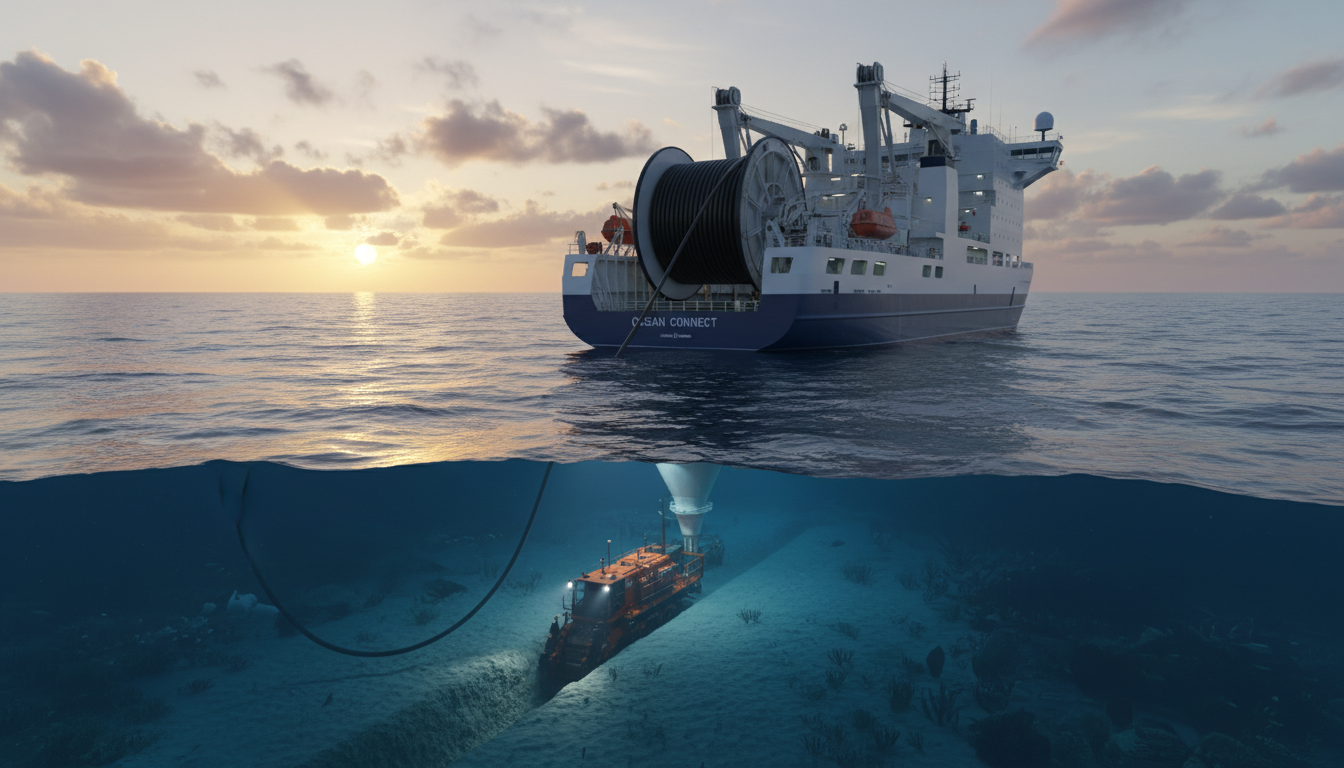
Taiwan lost an estimated $1.69 billion in just one month following submarine cable disruptions in early 2025, a stark economic blow that reveals the escalating geopolitical weaponization of the internet's hidden infrastructure. A vessel controlled by a Hong Kong company severed the Trans-Pacific Express cable, one of four disruptions Taiwan experienced that year. This wasn't an isolated incident; in February 2023, a Chinese fishing boat and a Chinese cargo vessel cut two cables connecting Taiwan's Matsu Islands to the mainland. These are not mere accidents; they are concrete examples of "gray-zone" warfare, actions designed to pressure opponents without triggering open conflict.
The Digital Chokepoint
China's expanding control over the global subsea cable supply chain creates a profound "Chokepoint Effect," enabling Beijing to disrupt or deny network access to adversaries during crises. This is not a theoretical threat. Between 95% and 99% of all international and intercontinental internet traffic, representing nearly all global internet traffic, relies on these submarine cables. This infrastructure is critical for financial transactions, including the SWIFT network, which processes approximately US$10 trillion daily.
Beijing's "Digital Silk Road" initiative aims to capture 60% of the global fiber-optic cable market. As of 2025, Chinese companies like YOFC, Hengtong, FiberHome, and Jiangsu Zhongtian Technology already controlled more than 35% of that market. HMN Technologies, formerly Huawei Marine Networks, stands as the world's fourth-largest and fastest-growing subsea cable builder. This dominance extends to the very foundation of the hardware itself: China controlled nearly 99% of the world's heavy rare earth element processing as of 2023, elements essential for subsea infrastructure. "For U.S. allies and partners, allowing China to dominate subsea cable construction and ownership in emerging markets would increase the risk that Beijing could conduct surveillance, intercept data, or deliberately disrupt networks," warned Jason Hsu.
Undersea Surveillance
Beyond disruption, China's undersea data center deployments facilitate pervasive surveillance and information control through a strategy of "weaponized interdependence". This includes the "Panopticon Effect," allowing for strategic intelligence gathering as global data flows through Chinese-controlled infrastructure. Beijing's "Great Underwater Wall," a network of sensors and unmanned underwater vehicles (UUVs), further supports this surveillance by observing maritime activity.
Software-Defined Networking (SDN) also plays a role, allowing for data rerouting that could facilitate interception. This comprehensive network of control and observation transforms the ocean floor into a new frontier for intelligence collection, creating vulnerabilities for any nation whose data traverses these routes.
Gray-Zone Pressure Points
The Taiwan Strait and South China Sea are identified as critical regions for geopolitical competition and potential "gray-zone" cable sabotage. The documented incidents in Taiwan illustrate this strategy in action, where China employs tactics intended to pressure opponents without triggering conventional war. Physical sabotage via UUVs and sensors poses a direct threat to international maritime security, a central component of this "gray-zone" warfare.
While submarine cables are inherently susceptible to accidental damage, the pattern of disruptions in these sensitive zones points to a deliberate strategy. The economic impact for Taiwan alone, an estimated $55 million per day, or $1.69 billion per month, shows the severe consequences of such actions.
The Strategic Trade-Off
China's push for Undersea Data Centers (UDCs) isn't solely about geopolitical advantage; it also offers significant operational efficiencies. UDCs can reduce energy consumption for cooling by up to 90% (a massive reduction) through natural seawater. A project in Shanghai, for instance, uses at least 30% less electricity than land-based centers and draws approximately 95% of its energy from offshore wind farms. Highlander is a leading developer in this space, especially for the Shanghai project.
This technological advantage, however, is deeply intertwined with strategic dependency. The UDC infrastructure, particularly the hardware and energy systems required for AI, relies heavily on China's near-monopoly over heavy rare earth element processing. This creates a complex dynamic: a pursuit of efficiency and carbon reduction that simultaneously entrenches a critical geopolitical vulnerability.
The Unseen Impact
The full, long-term environmental impact of scaling these undersea data centers remains a subject of scientific debate. While some warn of potential harm to marine biodiversity from thermal pollution, assessments of Chinese test projects indicate heat dissipation caused less than a one-degree temperature rise. What is clear, however, is the immediate and concrete geopolitical impact of China's expanding undersea infrastructure.


Comments ()