Palantir's UK Defense Lock-in Deepens
Politico.eu reported that the UK Ministry of Defence (MoD) directly awarded Palantir a £240 million contract in December 2025 for data analytics capabilities, following a previous £75 million contract in 2022.
Palantir's Black-Box AI Creates Accountability Gap
Palantir's proprietary "black-box" AI systems filter and prioritize information, yet their internal logic often proves unexplainable, even to their creators, Algorithmic Governance And Political Legitimacy reports. Article Jirfp V14p2 argues that redefining corporate accountability to distributed systemic risk and infrastructural authority creates an "accountability gap," rather than a clear transfer of liability from state leaders to algorithmic designers. This opacity, Article Jirfp V14p2 explains, complicates tracing the causal link between data inputs and lethal outputs, blurring distinctions in human intent that traditional legal frameworks assume. Responsibility for operational errors or unintended escalation thus becomes a distributed systemic risk shared among programmers, data preparers, and operators, according to Article Jirfp V14p2.
MoD Cites 'Significant Cost' to Change Palantir
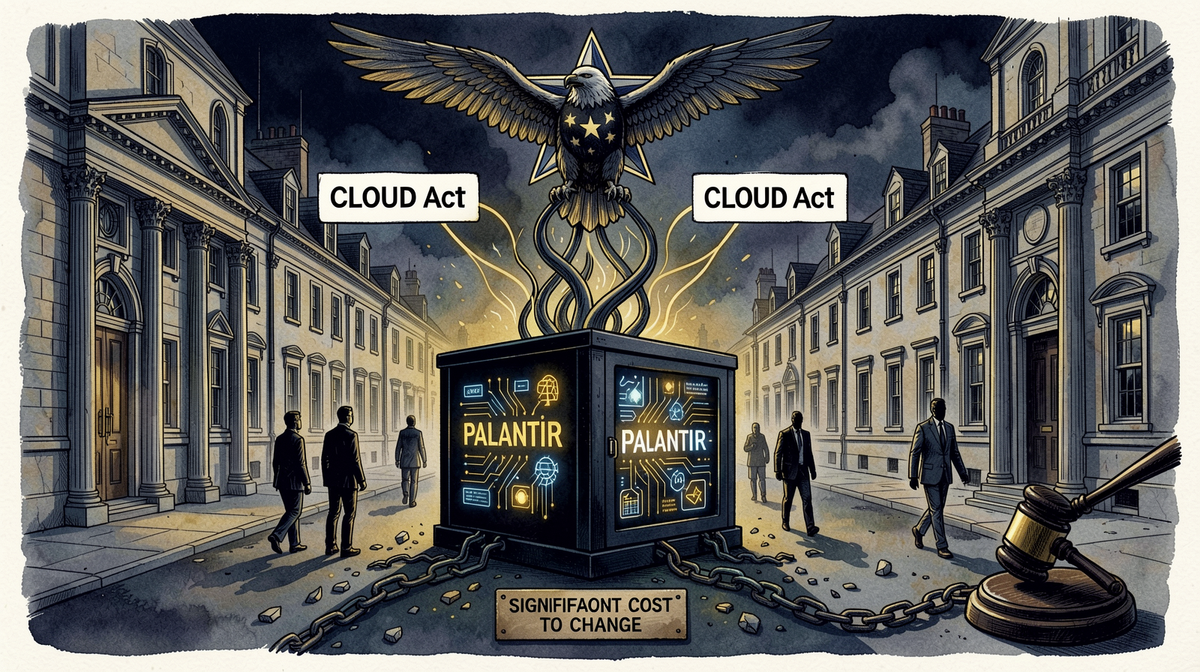
Politico.eu documented that the MoD justified the £240 million direct award by citing "significant cost" to change suppliers, necessitating the rebuilding of data analytics architecture, reaccreditation of systems, and retraining of personnel. Progressive International found that direct awards to Palantir, which often bypass competitive tender, are influenced by a "revolving door" phenomenon; senior MoD officials, such as Barnaby Kistruck, have joined Palantir shortly after leaving public service. This non-competitive contracting insulates decision-making from public scrutiny and creates significant technical lock-in, Politico.eu observed. Although Palantir's UK CEO Louis Mosley asserts "no technical lock-in" exists due to open-source frameworks and customer data ownership, critics and the MoD's own justifications indicate a structural dependence on proprietary elements like Palantir's Ontology, a proprietary data model, The Small Business Cybersecurity Guy points out.
Swiss Assessment Confirms US Access to Palantir Data
Progressive International revealed that a December 2024 risk assessment by the Swiss Armed Forces identified the US CLOUD Act, enacted in March 2018, as a mechanism allowing US intelligence services to access sensitive data; such leaks, the assessment concluded, "cannot be technically prevented," prompting Switzerland to pursue domestic alternatives for absolute autonomy. The Small Business Cybersecurity Guy argues that applying the US CLOUD Act, enacted in March 2018 to require US technology companies to disclose data regardless of its physical location, to Palantir’s UK defense infrastructure creates a binding legal dependency that constrains London's autonomous authority over conflict zones. While Palantir states that MoD data remains sovereign and is stored domestically within the UK, The Small Business Cybersecurity Guy clarified that this US legal mandate creates a pathway for potential US access that standard UK contractual terms cannot override. This extraterritorial reach generates a "compliance double-bind" with UK GDPR Article 48. The Small Business Cybersecurity Guy warns that Section 26 of the UK's Data Protection Act 2018 provides an exemption for national security and defense purposes, potentially allowing compelled disclosure of UK defense data to US authorities with limited domestic legal protection.
UN Rapporteur Cites Palantir's 'Unlawful Use of Force'
The UN Special Rapporteur's assessment of "unlawful use of force" highlights the risk of British operations becoming entangled in global ethical liabilities. This deep reliance on Palantir for critical defense functions creates a structural vulnerability for the UK, shifting accountability from traditional liability to distributed systemic risk and undermining autonomous military decision-making through technical lock-in and US legal mandates.


Comments ()